This fine, large coal hole cover is outside the Nat West bank on Pavilion Buildings near Brighton's Royal Pavilion.
I noticed it while queuing for the cashpoint and considering the footfall in this street it is in remarkably good condition. I was also pleased to note that the Council had obviously repaved the street with small setts and had resisted the temptation to remove the coal hole cover. Although I suspect that there were once many other covers in this street which failed to survive.
A blog commemorating the unique fusion of form and function of UK coal hole covers - Victorian urban street art at its finest.
Saturday, 28 September 2013
Monday, 2 September 2013
Kemptown glories
I've been told that Kemptown has many good coal holes, and so it should - being stuffed with fine Regency and Victorian homes needing copious amounts of coal. I had half an hour to kill the other evening and did a quick circuit of the streets to the south of the County Hospital.
I encountered a fine mix of people - skinny dodgy-looking yoofs with big scary dogs, large shaven-headed middle-aged men with small yappy dogs, ladies of leisure drinking red wine on their doorsteps and smooth couples in matching dressing gowns on their Regency balconies.
I also encountered a fine mix of coal hole covers, including some larger-than-normal ones and some from manufacturers not encountered further west. Feast your eyes on this lot.
First up, in Sudeley Terrace - a trio of Haywards covers in nice iron surrounds.
Moving on down to the seafront, on Chichester Terrace we find these great ones - some supersize like this Haywards with 19 glazed hexagonal panels.
And this nice chevron flower design.
And this very pleasing 'bullseye' Woodrow design.
this beautiful Clare, Hunt design from Shoreditch...
this unnamed design with slots in, and
a larger version of a fairly common design.
Round the corner, in Chichester Place there is this Haywards self-locking patent design 'D' model.
Tuesday, 2 July 2013
Clermont Road, Brighton
This fine unbranded 'starburst' cover is near Preston Park station in the Brighton 'burbs. It could possibly be from the Star Foundry, although stars are common motifs on coalhole covers.
Wednesday, 26 June 2013
Coal hole covers not worthy of listing - it IS official
A very efficient Conservation Officer at my local City Council has directed me to English Heritage's guidance for listing street furniture, which states,
" Fairly standard survivals of nineteenth-century paving are unlikely to be of sufficient special interest, atmospheric as they undoubtedly are; nor are coal hole covers designated, enjoyable as their cast iron forms can be. Nonetheless, examples of rare materials will warrant serious consideration, such as the Victorian patterned bricks that form the listed paving to West Street, Henley-on-Thames, Oxfordshire (listed Grade II). Other mechanisms may exist for their protection, notably their recognition via conservation area appraisals, and their retention during improvements and works."
This is disappointing, although it does indicate that rare coal hole covers could be worthy of protection and that they should be considered for protected during building works, which are both avenues worth pursuing. There are some covers that I've documented here that are rare within Brighton and Hove and worthy of some sort of protection from either developers or over zealous street improvements.
Saturday, 22 June 2013
It's official - coalhole covers not worthy of protection?
A few months ago, I emailed Brighton and Hove City Council in response to their call for nominations for the local list of heritage assets. Inclusion on the list would give coalhole covers a degree of non-statutory protection if a developer intends to damage or destroy them. And I thought it would also mean that the Council would be sensitive and try not to remove them if resurfacing a pavement. I think some of the finer examples would pass the criteria for interest and significance and I'm
tempted to nominate them.
I was slightly surprised and very disappointed to receive a reply that included this statement,
So I've just checked English Heritage's definition and it states (my underlining):
...means a building which is for the time being included in a list compiled or approved by the Secretary of State under this section; and for the purposes of this Act -
(a) any object or structure fixed to the building;
(b) any object or structure within the curtilage of the building which, although not fixed to the building, forms part of the land and has done so since before 1st July 1948,
shall be treated as part of the building."
A coalhole forms part of the land of a building and is therefore arguably within the curtilage.
English Heritage's guidelines for local listing does not mention coal hole covers nor manhole covers, so I am mystified at the Council's view and will be taking this up with them and English Heritage.
Save our coalholecovers!
I was slightly surprised and very disappointed to receive a reply that included this statement,
"The definition for locally listed buildings that we are applying to
the current review is based on English Heritage’s definition for listed
buildings. Their guidance states that coal hole covers cannot be
designated. As such, it will not be possible to include coal hole covers
in the city’s local list of heritage assets."
So I've just checked English Heritage's definition and it states (my underlining):
...means a building which is for the time being included in a list compiled or approved by the Secretary of State under this section; and for the purposes of this Act -
(a) any object or structure fixed to the building;
(b) any object or structure within the curtilage of the building which, although not fixed to the building, forms part of the land and has done so since before 1st July 1948,
shall be treated as part of the building."
A coalhole forms part of the land of a building and is therefore arguably within the curtilage.
English Heritage's guidelines for local listing does not mention coal hole covers nor manhole covers, so I am mystified at the Council's view and will be taking this up with them and English Heritage.
Save our coalholecovers!
Friday, 21 June 2013
Greville Street London EC1
A few hectic months at work have deprived me of chances to find new coalhole covers to document. However, another visit to the Hatton Garden area has delivered this beauty - a large cover with intact glass prisms and air vents, from an unknown manufacturer.
Location:
Greville Street, London, UK
Saturday, 23 February 2013
Coalhole covers in literature - part 1 Enid Blyton
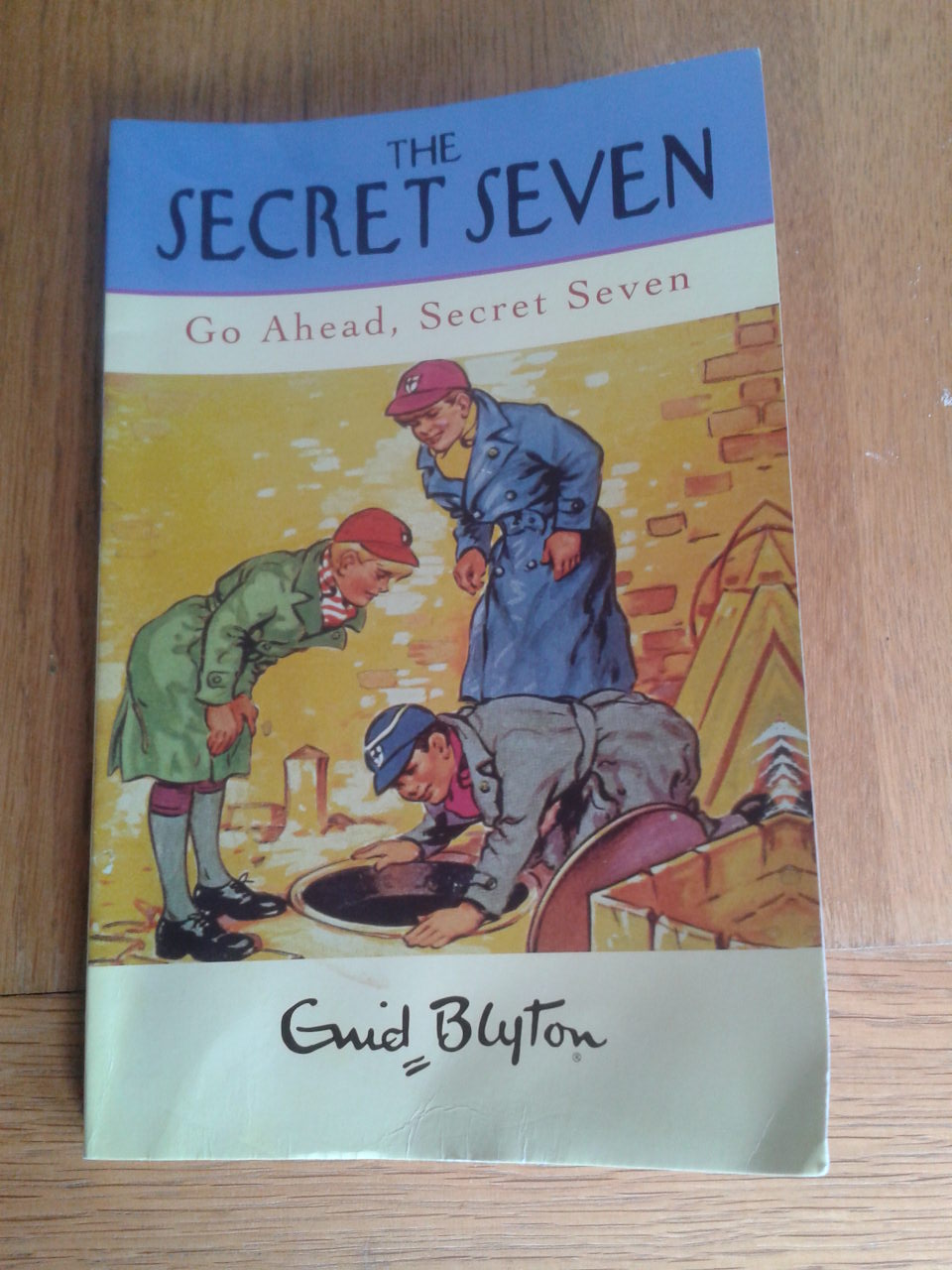
But imagine my unabandoned joy last night when I read the latest chapter of 'Go Ahead, Secret Seven' to my daughter. The chapter's title was 'Down the Coal-hole' and it featured a bull-terrier being lowered down the coalhole which was in a yard serving several buildings. I checked the book's cover and - sure enough - there's a picture of Colin, Herr Peter and AN Other lifting off the lid of a (rather large) coalhole. The description suggests that Enid Blyton was unfamiliar with the self-locking mechanism of Haywards (and other) foundries and I wonder if she actually checked out how they are secured. The picture on page 108 has a hint of the Luxfer 'cake' design, but the manufacturer of the cover is unfortunatley unknown.
Subscribe to:
Posts (Atom)