Saturday, 23 February 2013

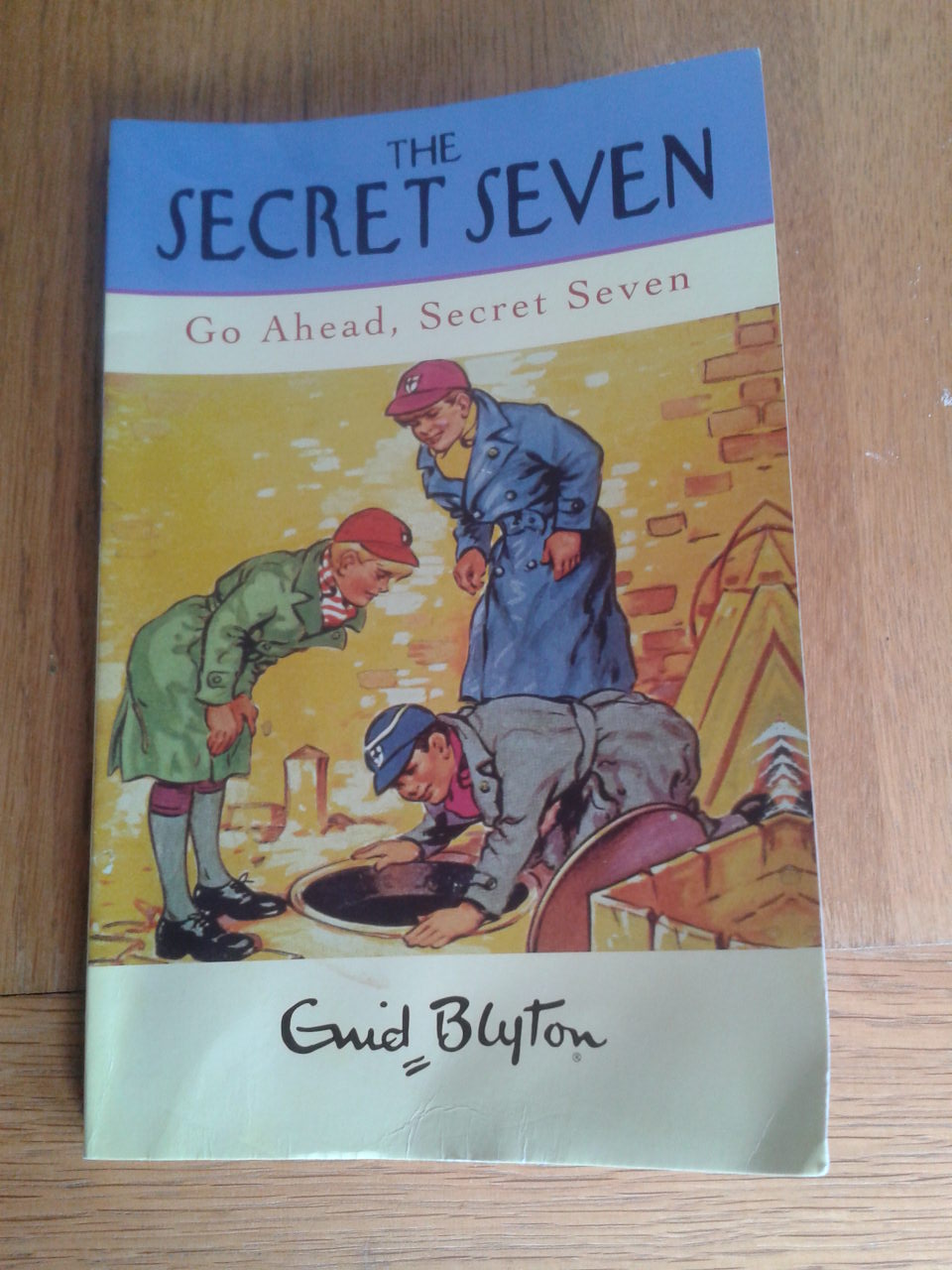
Coalhole covers in literature - part 1 Enid Blyton

My daughter has some lovely odd-parents who buy her great gifts. One of the first was a boxed set of Roald Dahl books which I loved as much as she did. Last Christmas they bought her a boxed set of Enid Blyton Secret Seven books. They are quite entertaining, although there is a whiff of 1950s embedded sexism and the leader of the Secret Seven (Peter, if you're interested) is a wannabe fascist dictator.

But imagine my unabandoned joy last night when I read the latest chapter of 'Go Ahead, Secret Seven' to my daughter. The chapter's title was 'Down the Coal-hole' and it featured a bull-terrier being lowered down the coalhole which was in a yard serving several buildings. I checked the book's cover and - sure enough - there's a picture of Colin, Herr Peter and AN Other lifting off the lid of a (rather large) coalhole. The description suggests that Enid Blyton was unfamiliar with the self-locking mechanism of Haywards (and other) foundries and I wonder if she actually checked out how they are secured. The picture on page 108 has a hint of the Luxfer 'cake' design, but the manufacturer of the cover is unfortunatley unknown.

Modern replacements - how not to do it


These two modern replacements are in Heene Terrace, Worthing and amply demonstrate how not to plug up an unused coalhole. There was an even worse example of one that had been concreted over. Surely as part of a Conservation Area and outside listed buildings (possibly even technically part of one as they are owned by the owner of the basement flat), the Council could have insisted on a more sympathetic replacement?

It would have been far better to have ordered one from a company like the Cast Iron Air Brick Company.

Go West pt 2 - Worthing


 Another trip to Heene Terrace in Worthing reveals a lovely horde of Pyke and Palmer coalhole covers from 140/141 Upper Thames Street, London - presumably the mother (or daughter) foundry of Palmers's Brighton - also found on Heene Terrace.

And at the top there's a large Hayward's coalhole cover. There are 2 different sized covers on this terrace which is interesting because all the properties were presumably built at the same time. Maybe the coalholes were installed later.

The bottom cover is presumably a replacement in a Pyke and Palmer surround. It looks rather fine. Unlike the ones in the next post. 

Saturday, 16 February 2013

Hatton Garden, London EC1


Visiting Hatton Garden from Brighton is a lot more pleasant now that the Thameslink service has been improved and Farringdon station has been upgraded in a rather tasteful way.

I was intrigued to find that Luxfer coalhole covers dominated the street. Luxfer was a foundry based in the Finsbury EC area of London and probably better known for its pavement lights. I particularly like the way the Luxfer covers look like sliced cakes, ready to be gobbled up.

There is also a Haywards coalhole cover (top) with a combination of glass inserts and holes - another first sighting, I think.

Wednesday, 6 February 2013

Go west - Worthing


Head west out of Brighton and Hove and, after clearing Shoreham and Lancing, you'll reach Worthing. It's a less racy place than B+H, but still boasts a fine pier, seafront and interesting hinterland of mainly Victorian streets. I'm lucky enough to work there and often enjoy a lunchtime constitutional stroll along the diddly om pom pom. My perambulations in search of coalhole covers have been slightly disappointing until this week.

Battling my way against a stiff westerly, I thought I'd investigate the pavement in front of Heene Terrace, a fine Regency (or maybe Victorian) terrace of 4 storey flats to the west of the pier. It is set back from the main promenade and the pavement is therefore less likely to have been resurfaced. Sure enough, there were a series of iron coalhole covers, all in very good condition. The one at the top is a large Haywards cover, but the other two pictured here are from Palmer and Company of Brighton, a foundry I've not encountered before. There were some other covers, but my phone ran out of juice. Watch this space.

The Worthing Civic Society do a fine job of protecting the town's heritage, but I can't find any reference to the coalhole covers on their website.

Tuesday, 29 January 2013

Antwerp coalhole covers?


After my disappointing (coalhole cover-wise) trip to France, I wasn't expecting much from a long weekend in the rather wonderful city of Antwerp. After wandering the streets, bars and museums of Antwerp, idly keeping an eye out for interesting person-holes, I noticed that many of the old buildings had semi-circular grilles in front of their doorsteps.

Peering down these holes, I couldn't see any window or other indication that these were to give light or ventilation to basements - indeed many buildings also had rectangular lightwells. Many of the grilles had chains attaching them to something in the abyss below.

Given Belguim used to have a vibrant coal industry, I assume these are examples of Belgian coalhole covers - possibly the first pictured on the interweb!

In a lovely modern Museum Aan de Stroom, I also found these intriguing medallions set into the floor slabs, designed by Tom Hautekiet, based on the plans for Palmanova, the ideal Renaissance city. They would make ideal coalhole cover designs.

 
  Other places I visited in Antwerp are reviewed here, but not the excellent bars.

Tuesday, 8 January 2013

East Street, Brighton

Strolling along East Street one recent evening, I was staggered to notice this fine Clarke, Hunt and Company cover. Why staggered? Because
1 I've passed this way thousands of times and never noticed it,
2 it's the first time I've seen a cover by this manufacturer in Brighton, and
3 its striking design including spirals, sunbursts and circles.

Happy New Year.